
ISSUE #45: Bug Happened to Me
Me, muttering: Aphids wouldn’t act like that. An aphid would never do that.

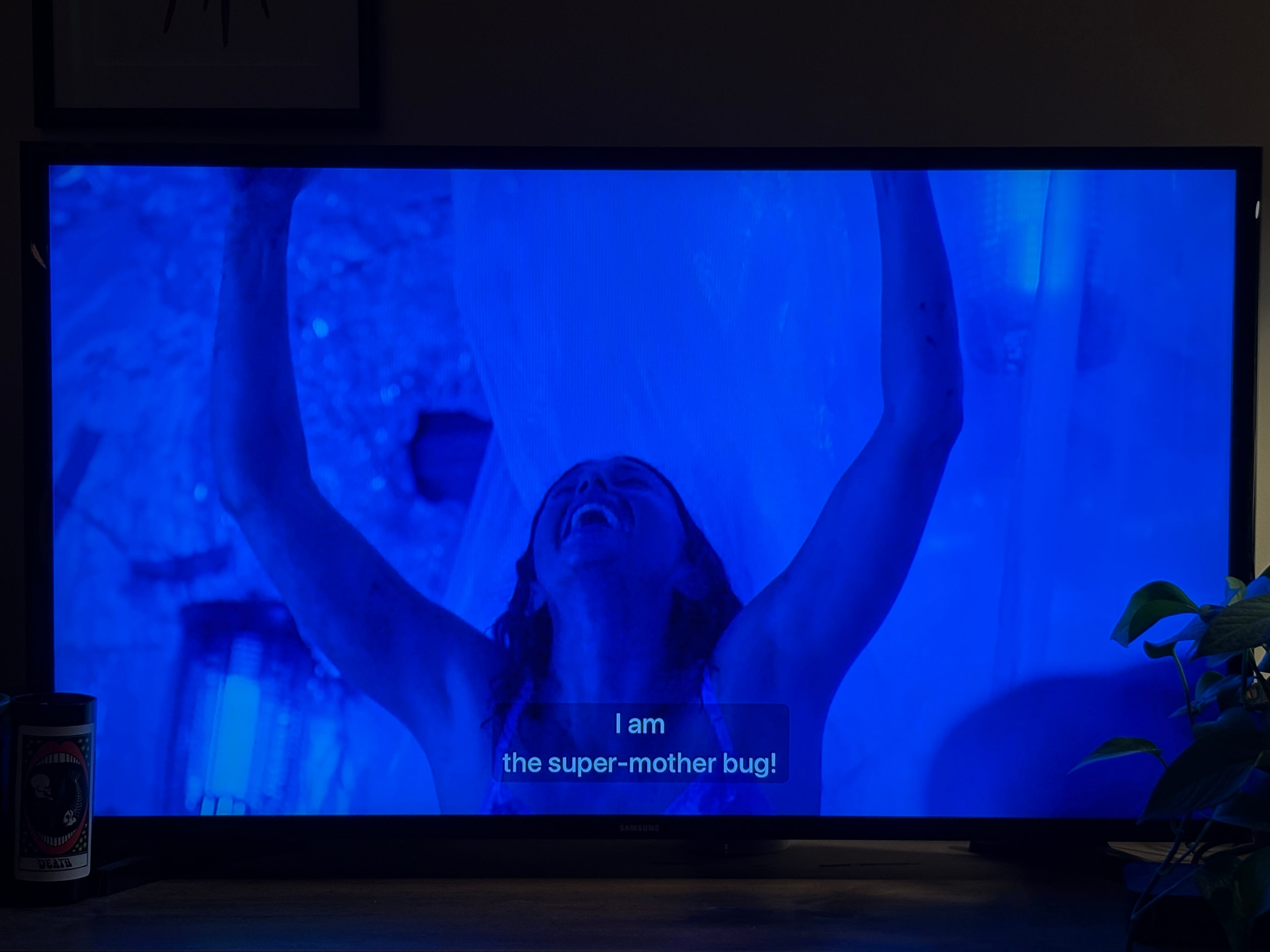
Earlier this month, my boyfriend and I went to see the second-to-last performance of Bug on Broadway. I had never seen the play or the William Friedkin adaptation, and all I really knew going into it was that it was written by Tracy Letts, sort of but not really about literal bugs, and more about government surveillance (the title being a clever double entendre, get it). It turns out, Bug isn’t really about either of those things at all. Instead, it’s mainly a very frightening, very tragic tale of two people who accidentally trap themselves in a paranoia-fueled folie à deux—a phrase everyone else learned when the Joker sequel came out, but that I learned all the way back when Fall Out Boy released their fourth album.
In Bug, a woman named Agnes who lives in a motel hiding from her abusive parolee ex-husband meets a Gulf War veteran named Peter who believes himself afflicted with bloodborne microscopic insects manufactured by the U.S. government that spread through physical and sexual contact. The two wake up one morning certain that they’ve been bitten in the night by tiny bugs—they call them “aphids” in both the play and the movie (probably the most wrong type of bug you could blame for a situation like this, but I’ll let it slide) and they “see” them everywhere. They set glue traps and flypaper all over the motel room, replace their lamps with bug-zappers, and pick patterns of sores into their skin, convinced beyond all doubt that bugs are living on and inside their bodies. I won’t spoil the ending, but it doesn’t end well.
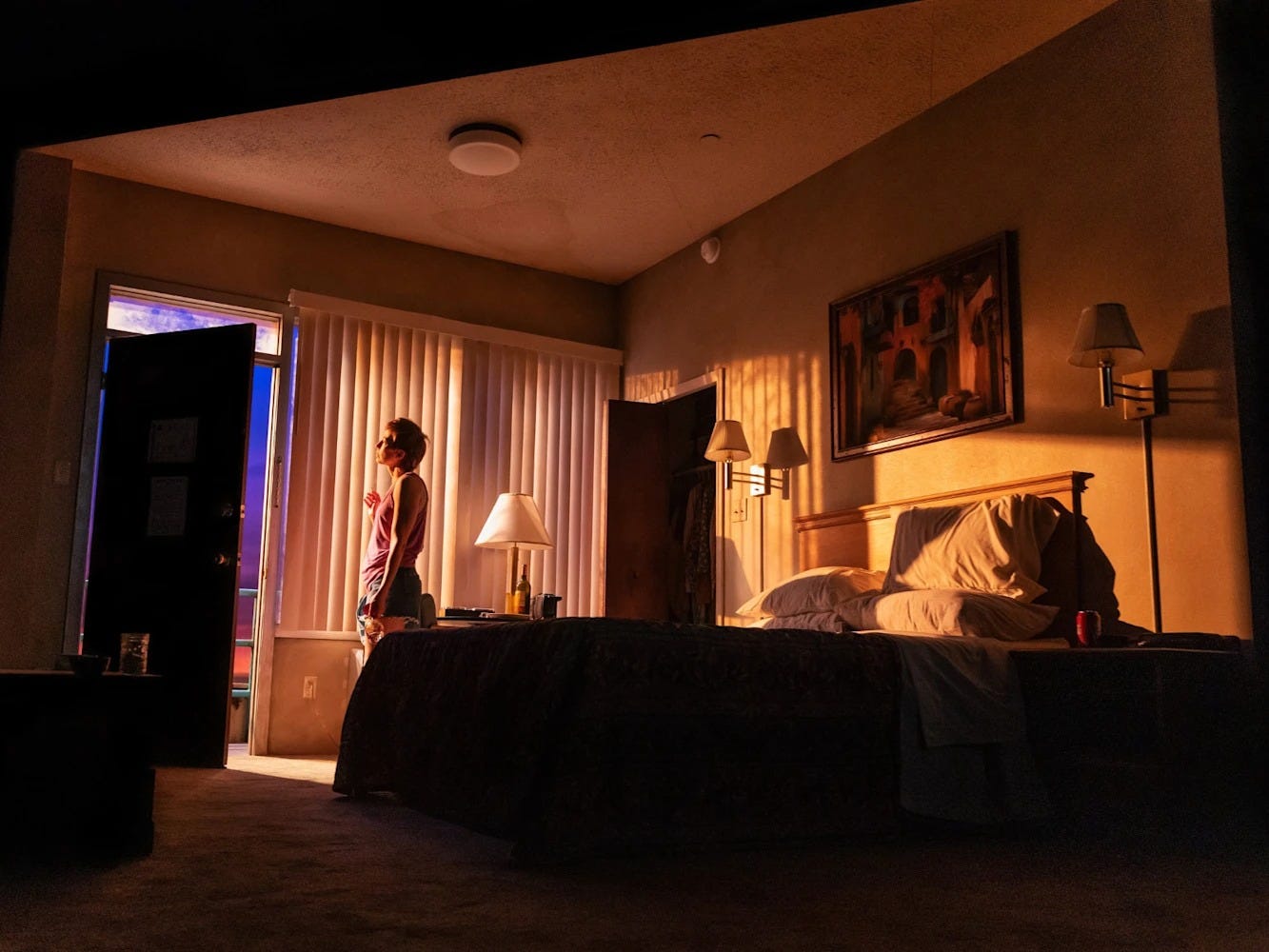
I loved the play, which starred Letts’ wife and prolific Letterboxd poster Carrie Coon (awesome) as Agnes and Namir Smallwood as Peter. It was about as intense as it sounds, but also very moody and sad, with a fantastic single motel room set that was somehow wallpapered entirely with aluminum foil during a particularly harrowing scene change. They locked our phones in Yondr pouches before we took our seats, which had the added effect—maybe intended, maybe not—of further putting us off balance without the security of scrolling before the play had even started.
A few days after, I watched the movie on Tubi, which was not quite as emotionally affecting but equally intense—Ashley Judd and Michael Shannon (who originated the role onstage) are a crazy combo of actors and Friedkin plays them off of each other really well. If I didn’t already know Michael Shannon was a movie star I would 100% believe he was a guy who thought he had bugs swimming around under his skin.

I found both Bug (play) and Bug (movie) personally affecting, not because they’re “about bugs,” which they’re not, but because they’re a very vivid dramatization of the paranoia that really does come with an actual bug infestation in your home. A few years ago, I was victimized by clothes moths, a colony of which took up residence on a section of my living room rug that was under a piece of furniture and so didn’t get vacuumed as often as it should have. If you haven’t had them, clothes moths are horrific: they’re small and avoid light so they can’t be dealt with by any traditional means; they reproduce rapidly, finding any crevice of your home that might house a few edible morsels; and they eat any clothing and decor made with natural fibers, so good luck to all your wool coats and cashmere sweaters. I found a hole in a beloved cable-knit from Ireland that was so big my mom had to patch it up for me.
I researched these moths so thoroughly and so obsessively over a period of 18 months that I’m pretty confident I know more about them now than even a professional exterminator might. I know what they look like, what their larvae look like, what their eggs look like, how long their life cycle takes to complete, what kinds of fibers they prefer over others, what time of year they’re most active. I can tell the different species apart (there are three) just by watching how they fly through the beam of light cast by my lamp. If I saw one perched on a wall or flying around my apartment at night, I wouldn’t be able to go to bed until I had killed it.
People who have dealt with bedbugs say that the psychological toll an infestation like that takes on you is worse than any physical discomfort. My moths are not the biting kind, but I would say my experience was similar. I would see them out of the corner of my eye even when they weren’t there. I would scour my rug with my fingers, pulling apart fibers to see if I could find their cocoons. My cat Seb got so used to seeing me paw around on the furniture—I would let him eat them when I found them—that he gets excited now even if I’m just rearranging a blanket. When he stops and stares into the distance, I wonder for a second if he sees a moth, not unlike Agnes taking her cues from bug-obsessed Peter. Or maybe Seb is Agnes and I’m Peter. Sometimes it’s hard to tell.
Because of this, I felt a kinship with both of Bug’s characters that maybe I wouldn’t have felt if all insects were to me were fun, friendly little creatures who lived outside and didn’t bother me in the comfort of my own home. Because I know what it is to be parasitized against my will, and to annihilate my tiny enemies with my bare hands, I understood, to a degree, how easy it was for Agnes to slip into Peter’s madness. My moths taught me that all things have a dark side, even me. Even bugs.
I thought Bug was lowkey romantic... am I crazy