
ISSUE #41: Go Outside While You Still Can
It’s so joever, etc.

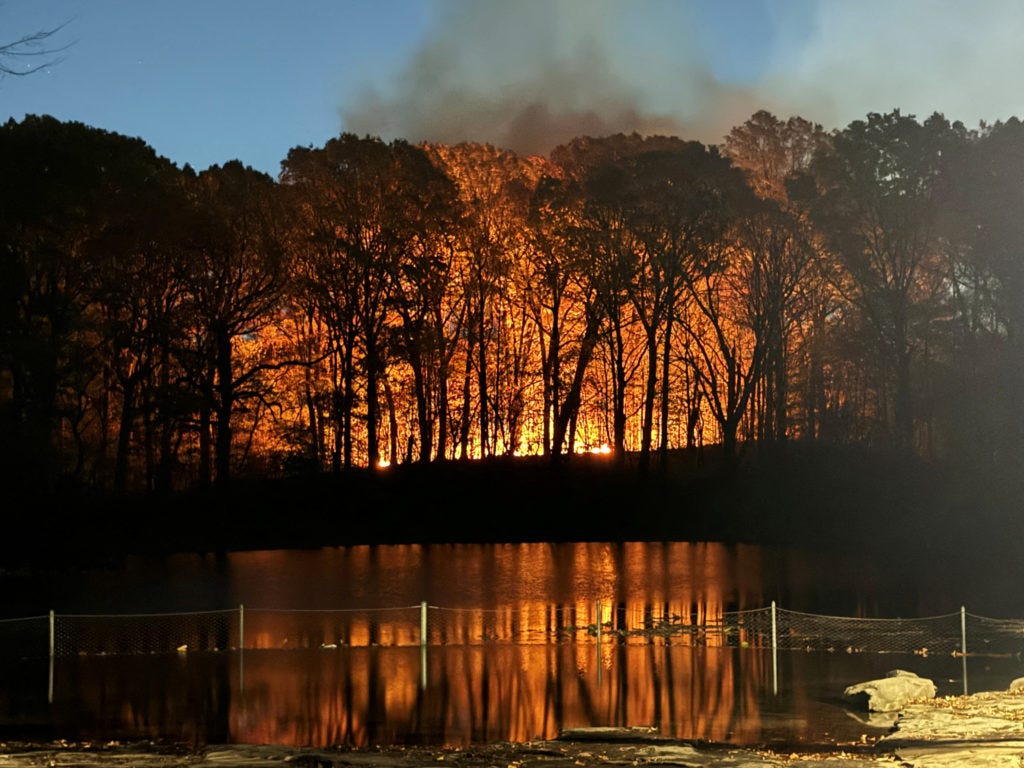
Last week, New York City was officially suffering a drought. We were advised to conserve water and take shorter showers because it hadn’t rained for real since September 29. (On October 29, Central Park recorded a rainfall of 0.1 inches, the lowest possible measurable amount.) Wind blew smoke from brush fires in New Jersey straight towards the city. Prospect Park caught on fire. The air quality index was stuck on “very unhealthy.” The mayor banned grilling in public parks until further notice. I had a severe weather alert on my phone for days.
The incoming president has again promised to remove America from the Paris Climate Agreement. On Monday, he appointed former New York Representative Lee Zeldin as the new head of the Environmental Protection Agency. During his tenure in the House, Zeldin received the worst score from the League of Conservation Voters out of the whole NY delegation in 2020.
“It is an honor to join President Trump’s Cabinet as EPA Administrator. We will restore US energy dominance, revitalize our auto industry to bring back American jobs, and make the US the global leader of AI. We will do so while protecting access to clean air and water,” Zeldin tweeted.
That first point is an obvious dig at China, the only country to produce more energy than the U.S, and the world’s largest emitter of fossil fuels. We’re going to have to start employing more American workers in every industry once these looming tariffs make parts too expensive to import. And training a large language model AI program requires the same amount of energy consumed annually by a small country in units of fresh water, and that energy use is only increasing (on a trajectory that concerns even Goldman Sachs).
The main part of this tweet, though, is the last part, the “protecting access” part. Taking single posts at face value and extrapolating the most evil meaning out of them is one of the reasons why being online is so generally bad, but the phrasing here is something I can’t get past. The sentence is not: We will clean the air and the water. There is no plan to fix anything. What matters most to this president and his cabinet is protecting access to what precious resources we have left.
This is the climate crisis. This is how it will, ultimately, manifest—not with world-ending geostorms cinematically ripping through major cities, but with those with means jealously hoarding all the good stuff for themselves while the waters and fires inch closer to the rest of us.
Don’t expect many tears for the climate’s dwindling stability to come from someone who spends most of his time at a golf course whose runoff drains into the waterway that surrounds the coastline of a state whose rampant industrialized destruction of its own natural storm barriers is one of the reasons why its residents will get walloped harder and harder by every hurricane that turns east across the Gulf.
What do we do about any of this? I don’t know. We can wallow in despair about the destruction of the world and channel half of that energy into anger towards the political party so bent on destroying it, and the other half towards the opposition, whose main interest seems to be wasting money. We can talk hopefully about the 2026 primaries. We can stop giving what resources we do control—money, attention—to websites and politicians and public figures who don’t serve us. We can stop shopping. We can also stop posting on social media, or at least stop looking at it so much, both for our own mental health and to keep the bot farm grifters and the outrage bait leeches and the (alleged) blood emerald billionaires who proudly despise their trans daughters from stealing our waking hours away from us. We can spend less time online in general, (but not completely—how else would you read Bugstack??).
I was sad when the results of the election were announced, because I knew what was coming in this case, and I’m even sadder now that I can see what kind of shape it will take. I’m sad that my and many other people’s main advice in times like these—go outside—might not be an option ten to twenty to fifty years from now. I’m sad that what is important to me seems to be a negligible issue to others, but then again I do publish a sporadic newsletter about bugs.
Again, what do we do? Again, I don’t know. I try not to be too hopeless in situations like this, simply because we are living through things that have never happened before. The planet is resilient, and has suffered much worse. Ecosystems can be brought back to equilibrium. The whales came back. Bees are coming back. These things only happened because we took responsibility for the past and worked positively toward a better future. The only advice I have to give sounds too corny to post but is also too true to ignore. Cherish rainy days. Have conversations with real people—family, friends, neighbors, coworkers—about how great it is that water comes down from the sky and saturates the tiny, tiny layer of soil sitting on the crust of the planet that makes things grow. Care for a plant, or a garden. Cultivate your appreciation for everything tiny and small and vulnerable whose time on this earth is as temporary—and as precious—as our own.
Thought filled. Very well done.
love this one